Wednesday, September 12, 2012


Monday, September 10, 2012
Ethiopian irridentist regime liberate Swedish journalists
Two Swedish journalists who have been imprisoned in Ethiopia for more than a year have been liberaed and are set to be freed, Ethiopia's justice minister announced Monday.
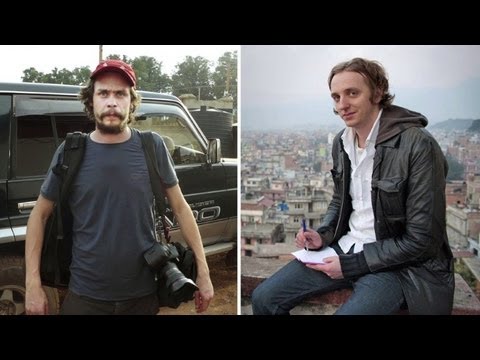 Minister Berhan Hailu told reporters in the Ethiopian capital, Addis Ababa, that the decision to liberate photographer Johan Persson and reporter Martin Schibbye had been approved by the late Ethiopian Prime Minister Meles Zenawi.
The Swedish journalists are among 1,923 convicts in prisons around the country who are getting amnesty, he said, adding that only those who show remorse can be pardoned. The Ethiopian government has over the years released hundreds of prisoners in a ceremony timed to coincide with the start of the new year according to Ethiopia's calendar.
"The two Swedes are among the ones to be released," Berhan said. "The decision to pardon them was made in July."
The minister could not say precisely when the journalists would be released from jail, saying only that this might happen within the next 24 hours.
Persson and Schibbye have been in jail since July 2011, when they were arrested while trying to cross from Somalia into Ethiopia's Ogaden region along with fighters from the separatist Ogaden National Liberation Front, which Ethiopia classifies as a terrorist group.
Last December the journalists were sentenced to 11 years for abetting terrorism and entering the country illegally. They denied the terror charges, saying they were in Ethiopia simply to do their work as journalists. Their jailing was condemned by rights watchdogs such as the Committee to Protect Journalists, which said their trial was "an affront to justice and press freedom."
Friday, September 7, 2012
Three journos held since 2001 die in Eritrea prison camp
After several weeks of investigating reports from sources in Eritrea and from prison guards who fled the country, Reporters Without Borders has been able to confirm that three more journalists - Dawit Habtemichael, Mattewos Habteab and Wedi Itay - have died in the northeastern prison camp of Eiraeiro. All three had been held since late 2001.
Another journalist arrested in February 2009, whose identity has not been established with certainty, has also reportedly died in detention - in his case, in Abi Abeito military prison near the capital, Asmara.
The only good news is that Tesfalidet "Topo" Mebrahtu, a well-known sports journalist who worked for state-owned radio Dimtsi Hafash and state-owned Eri-TV, was "released on bond" (he is still under surveillance, with relatives acting as guarantors) in early 2012 after being held for 10 months.
"While all eyes are turned on Syria, another, less visible, tragedy is being played out in Eritrea, a country forgotten by the international community although it is the world's leading media freedom violator and Africa's biggest prison for journalists," Reporters Without Borders said.
The only good news is that Tesfalidet "Topo" Mebrahtu, a well-known sports journalist who worked for state-owned radio Dimtsi Hafash and state-owned Eri-TV, was "released on bond" (he is still under surveillance, with relatives acting as guarantors) in early 2012 after being held for 10 months.
"While all eyes are turned on Syria, another, less visible, tragedy is being played out in Eritrea, a country forgotten by the international community although it is the world's leading media freedom violator and Africa's biggest prison for journalists," Reporters Without Borders said.
Wednesday, August 29, 2012
Ethiopia frees prominent journalist, drops all charges - Committee to Protect Journalists
Ethiopia frees prominent journalist, drops all charges
New York, August 28, 2012--The Committee to Protect Journalists welcomes today's decision by the Ethiopian Ministry of Justice to release the editor of a leading independent weekly from jail and drop all criminal charges against him. CPJ also calls for the release of eight other journalists now imprisoned in Ethiopia for their work.
Temesghen Desalegn, editor of Feteh, was released from Kality Prison in Addis Ababa, the capital, at around 3 p.m. today, according to Feteh Deputy Editor Hailemeskel Beshewamyelhu. The journalist was jailed on Friday in connection with his articles that appeared in seven editions of Feteh and criticized the policies of the late Prime MinisterMeles Zenawi, according to local journalists.
Charges against Mastewal Publishing and Advertising PLC, the company that publishesFeteh, were also dropped, according to news reports. The company had been charged with inciting the public to violence by publishing Feteh, according to a charge sheet reviewed by CPJ. Temesghen faced criminal charges including defaming the state and inciting people to overthrow the government, the sheet said.
Desalegn Teressa, spokesman for the Ministry of Justice, told Bloomberg News, "After further investigation, the prosecutors have decided to drop the charges." But the government did not give an explanation as to why the charges against Temesghen and Mastewal Publishing had been dropped.
Feteh has not been published since July 20, when the government ordered Barhanena Selam, the state-run printing company, not to print the paper. The ministry blocked the distribution of a Feteh edition with a front-page story about the conflicting reportssurrounding the illness of Meles, according to news reports. It was not immediately clear whether Feteh would be able to resume publishing.
"We're relieved Temesghen Desalegn has been freed and will not face criminal prosecution for his journalism," CPJ Africa Advocacy Coordinator Mohamed Keita said. "We call on Ethiopian authorities to demonstrate a commitment to freedom of expression by releasing the eight other journalists currently imprisoned for their work and by ending the government's practice of prosecuting journalists who voice dissenting views."
Among the eight journalists in prison is independent blogger Eskinder Nega, who has been sentenced to 18 years in prison on charges of participating in a terrorist organization and inciting anti-government protests, according to CPJ research.
- For more data and analysis on Ethiopia, visit CPJ's Ethiopia page here.
Tuesday, August 28, 2012
Ethiopia Drops Charges Against Critical Newspaper Editor - Businessweek
Ethiopia’s Justice Ministry said it won’t prosecute the editor of the weekly newspaper Feteh, whose distribution was blocked after it reported on the illness of late Prime Minister Meles Zenawi before his death this month.
“After further investigation the prosecutors have decided to drop the charges,” Desalegn Teressa, a ministry spokesman, said in a phone interview today from the capital, Addis Ababa.
Ethiopia has been criticized by the United Nations and advocacy groups including the New York-based Committee to Protect Journalists over legislation that restricts freedom of expression.
Feteh’s editor, Temesgen Desalegn, had been facing four charges including attacking the state by defamation and inciting young people to overthrow the government, based on articles published between July 2011 and March, Amnesty International said on August 24. He has been released from the prison where he was held after his first appearance at court last week, said Hailemeskel Beshewamyelhu, an editor at the newspaper.
Feteh, which distributed around 30,000 copies in Amharic and was frequently critical of the government, has not been printed by the state-owned Berhanena Selam Printing Enterprise since the ministry ordered the impoundment of its July 20 edition. Last week the management said it is still not prepared to publish the newspaper, Hailemeskel said.
A 2008 media law allows distribution of a newspaper to be blocked if it presents “a clear and present grave danger to the national security.”
To contact the reporter on this story: William Davison in Addis Ababa at wdavison3@bloomberg.net
To contact the editor responsible for this story: Antony Sguazzin at asguazzin@bloomberg.net
Monday, August 27, 2012
Mixed reaction on social media to death of Ethiopian PM-BBC
Social media users across Africa have been giving mixed reactions to the official announcement of the death of Ethiopian Prime Minister Meles Zenawi.
Some commentators consoled Ethiopians and the late PM's family, and hailed the late PM for bringing political stability.
Others were critical of Mr Meles, especially of his leadership style, democratic credentials and decision to seek treatment abroad.
Social media commentators in several African countries sent their sympathies to Ethiopia.
Reacting to the news on the Facebook page of Kenya's NTV station, "Kibet Felix Koech" said: "2012 is not a good year for African leaders, may his soul rest in peace."
Numerous African leaders have died in 2012, including President Bingu wa Mutharika of Malawi, Guinea-Bissau's Malam Bacai Sanha, and John Atta-Mills of Ghana.
On Twitter, "James Munyaneza", who describes himself as a Rwandan journalist, pays tribute to Meles: "#Rwandans join #Ethiopians in mourning their fallen leader. The PM [prime minister] has been a close friend of the people of #Rwanda. #RIPMelesZenawi".
Another Rwandan Twitter user, "Ladislas Ngendahiman", echoes her compatriot's remarks, saying: "#Rwanda has lost a true friend and hero! RIP".
'Ethnic violence'
There is also anxiety evident in many users' comments, and a sense that Mr Meles's death could lead to unrest in Ethiopia.
Twitter user "Fatou Toure", who describes herself as expatriate, says the PM's death "is terrible news even though I was not his fan. I'm just hoping the transition is peaceful."
Another Ethiopian Twitter user, "Buff Balcha", says: "I'm so scared for my country right now #Ethiopia #Meles".
"Gerald Mahinda", writing on NTV's Facebook page, expresses fears of imminent religious conflict in Ethiopia, saying "the civil war between Christians and Muslims is about to start!"
This is in reference to recent Muslim protests in the capital Addis Ababa.
On the Facebook page of South Africa's Mail & Guardian newspaper, "Brenda Cadillac Madisha" praises Mr Meles for stabilising Ethiopia, but is also fearful about the country's future, saying: "I believe that he became the glue that held Ethiopia together judging by the near stability that Ethiopia experienced over the last decade or so and the millions of dollars that it got."
The user adds: "I am afraid now that Meles is dead the ethnic violence that erupted in Ethiopia will come back and haunt Ethiopia again. RIP Zenawi."
Meanwhile US-based Twitter user "Simret Zeru, Esq.", writes: "Before you start celebrating in the streets over the death of Meles Zenawi, consider its implications. He might've been the lesser evil."
Many social media commentators have been critical of Mr Meles, and the legacy he leaves behind.
Twitter user "Mohammed Ademo", a US-based journalist, says: "#Meles had repeatedly called his predecessor Mengistu a butcher. For many Ethiopian youth my age, his legacy is no different. #Ethiopia".
"Fisseha Tegegn", who describes himself as a London-based journalist, criticises those mourning Mr Meles's death, tweeting: "You can express your feelings in whatever way you want but please, don't try to tell me that it is a sad day for Africa. No, it is not!"
Meanwhile on the Facebook wall of the South African Mail & Guardian newspaper, "Ranyabane Clive Polile" criticises the African political elite for seeking medical treatment overseas, saying: "African despots don't use public facilities they build for their own people. Condolences to the people of Ethiopia for their loss".
BBC Monitoringselects and translates news from radio, television, press, news agencies and the internet from 150 countries in more than 70 languages. It is based in Caversham, UK, and has several bureaux abroad. For more reports from BBC Monitoring, click here
Subscribe to:
Posts (Atom)