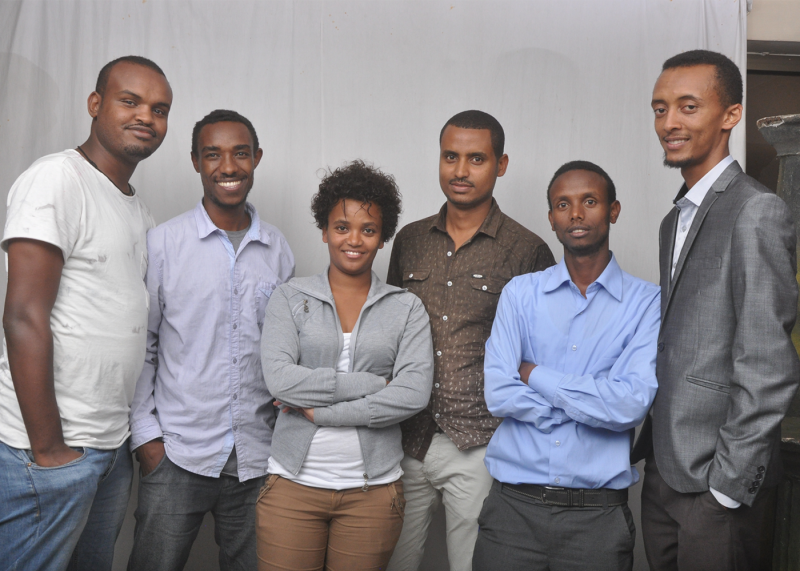
Ethiopia Supreme Court says two Zone 9 bloggers should face incitement charges - Committee to Protect Journalists: "Ethiopia Supreme Court says two Zone 9 bloggers should face incitement charges Text Size Print Share Members of the Zone 9 blogging group. (Endalkachew H/Michael) New York, April 6, 2017--Ethiopia's Supreme Court today ruled that two bloggers from the Zone 9 collective, previously acquitted of terrorism charges, should be tried instead on charges of inciting violence through their writing. If convicted of the charge, Atnaf Berhane and Natnail Feleke would face a maximum prison sentence of 10 years, according to the Addis Standard newspaper. The court upheld the lower court's acquittal of two other Zone 9 bloggers, Soleyana S Gebremichael and Abel Wabella. Today's actions by the Supreme Court were a response to prosecutors' appeal of the October 2015 acquittal of all four. "We urge Ethiopian authorities to do the right thing and drop any further prosecution of Atnaf Behane and Natnail Feleke on charges relating to their work," said Africa Program Coordinator Angela Quintal. "Today's acquittal of two Zone 9 bloggers is a positive step, but there can be no celebration until this exhibition of legal harassment ends once and for all." Ethiopia ranked fourth on CPJ's 2015 list of the 10 Most Censored Countries and is the fifth worst jailer of journalists worldwide, according to CPJ's 2016 prison census. CPJ awarded Zone 9 an International Press Freedom Award in 2015. For more data and analysis on Ethiopia, visit CPJ's Ethiopia page."
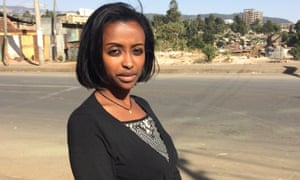
Bezawit Hailegiorgis, wife of the detained blogger and journalist Anania Sorri. Photograph: Jason Burke for the Guardian"Bezawit Hailegiorgis says western powers could help free Anania Sorri, one of tens of thousands held in Ethiopia since last year Bezawit Hailegiorgis, wife of the detained blogger and journalist Anania Sorri. Photograph: Jason Burke for the Guardian View more sharing options Shares 1,188 Jason Burke in Addis Ababa Monday 27 February 2017 06.00 GMT The wife of a blogger and journalist detained in Ethiopia has called on the international community to pressure local authorities to release her husband, who is among tens of thousands held since a state of emergency was declared in the emerging east African power last year. Anania Sorri, a 34-year-old writer and intellectual, was arrested in November on his way to a meeting at the US embassy in Addis Ababa. He is being held in a high security prison in the Ethiopian capital and has not yet been formally charged with any offence. Bezawit Hailegiorgis, 29, his wife, said his sole crime had been “to express his thoughts honestly”. “His crime is his determination to speak out. He is a brilliant political journalist. He was critical but always constructive … but being imprisoned is part of the job description of being a journalist here. It’s a zero-sum game, where someone has to lose, and at the moment they are not losing,” she told the Guardian."
Human rights groups have criticised the failure of western powers to condemn Ethiopia’s recent crackdown, which followed a new wave of protests against the ruling Ethiopian People’s Revolutionary Democratic Front (EPRDF) coalition.
The US and UK see Ethiopia as a key stabilising actor in east Africa and rarely criticise authorities there. Addis Ababa has long been viewed by both as an important partner in the fight against Islamic militancy in the volatile region. The EU increasingly sees Ethiopia as an important part of the European effort to reduce the flow of migrants from east Africa.
Hailegiorgis said international pressure on the government would prove effective in her husband’s case. “I love my country … and I do understand that this is a sovereign country, but we all live in one system and the UK, the US and others do have leverage. Of course pressure would work,” she said.
Hundreds of people are thought to have been killed and tens of thousands detained in Ethiopia over the last year, though exact figures are unavailable. Opposition groups, mostly based abroad, say the figure is much higher. The government recently said it had released 11,000 detainees.
Scores of senior opposition politicians have been arrested and jailed, as well as bloggers and commentators such as Sorri.
The unrest has been most intense in areas dominated by the Oromo ethnic group, which comprises around 40% of the population. There have also been demonstrations and clashes in parts of Ethiopia dominated by the Amhara ethnicity, which analysts say indicate a deep-rooted discontent with decades of rule by the EPRDF.
The overall situation appears to have calmed since an upsurge in protest and associated violence in November, though some areas remain tense.
Ethiopia ranks 142nd out of 180 countries for press freedom, according to the Reporters Without Borders campaign group.
Diplomats in Addis Ababa described a “gulf between the outside perception of Ethiopia and what is happening inside the country”, branding the repressive atmosphere a “climate of fear”.
Although restrictions on the internet and social media have been eased, there has been little significant let up in the repressive security measures.
Hailegiorgis said she recognised she was taking a risk by talking to international media, as others have been detained for doing so.
She said her husband had been arrested without warning under special powers introduced with a state of emergency in October and was unsure of exactly what offence he was suspected of committing. He has not been allowed legal representation, has been denied books or newspapers, and is being held in a cell with around 40 others. Hailegiorgis is allowed to visit him when she wants, with their three-year-old daughter, and to provide her husband with food and medication.
“Anywhere else he would win prizes and acclaim. He was not a criminal, not involved in politics, and not violent. Here, he goes to jail,” Hailegorgis said.
The EPRDF, which has been in power for 25 years, has been praised for bringing millions of Ethiopians out of poverty and ensuring growth rates that have averaged around 10% for more than a decade.
However, corruption and unequal distribution of the new wealth, coupled with a young and increasingly educated population, have meant growing discontent.
The unrest has been described by some analysts as “a political crisis” for a state that has increasingly followed an “authoritarian Chinese-style development model”. Ethiopia has built commercial and other ties with Beijing in recent years.
The prime minister, Hailemariam Desalegn, who took over following the death of the veteran leader Meles Zenawi in 2012, has promised political reforms and reshuffled his cabinet in November in an apparent effort to be more inclusive. He has also launched a huge programme of spending aimed at improving the lot of young people. The median age in Ethiopia is 18 and a vast expansion of further education has led to enormous demand for graduate jobs, which the country is struggling to meet.
Many among the Oromo minority frame social and economic problems in ethnic terms. They say the government is dominated by Tigrayans, who comprise only 6% of Ethiopia’s 100 million inhabitants.
“The unrest and protests are rooted in decades of marginalisation and exploitation … if there is no democratic way of protesting, then there will be violence. That is inevitable,” said a 42-year-old Oromo activist in Addis Ababa who did not want to be named.
In an interview with the Guardian, Negeri Lencho, the communications minister, said journalists who had been jailed had either not “respected the ethics of the profession” or were not actually journalists at all.
“Ethiopia is facing challenges – political, economic, social – and journalists should understand the problems we face today and should provide the right sort of information our people need,” Lencho said.
“All members of the cabinet and the prime minister … all want to see a vibrant media … but a journalist has a purpose, if he is a real journalist, to reach out with the right information, not just his own opinion, be it hate or love.”
Hailegiorgis said pressure from the west could help obtain freedom for her husband.
“The international community is not doing anything at all. It’s a bizarre thing. It’s just lip service, just words. They say they are ‘highly concerned’ or ‘concerned’ but then … nothing,” said Hailegiorgis.
New York, January 4, 2017--The Committee to Protect Journalists today condemned the prison sentences handed down to two journalists from the Ethiopian faith-based station Radio Bilal. Khalid Mohamed and Darsema Sori were sentenced yesterday to prison terms of five years and six months and four years and five months respectively, the independent news website Addis Standard reported.
Nairobi, December 21, 2016--Ethiopian radio journalists Khalid Mohammed and Darsema Sori, who have been imprisoned since February 2015, were today convicted on terrorism charges by the High Court's 19th Criminal Bench, according to the independent Addis Standard newspaper.
ADDIS ABABA (Alliance News) - The Ethiopian government has "systematically and illegally blocked access to social media and news websites," including messaging app WhatsApp and 16 news outlets, according to a report released Wednesday by Amnesty International.
The interference, meant to "crush dissent" and prevent negative press, affected access to websites of independent news organizations and political opposition groups, among others, according to research by Amnesty and the Open Observatory of Network Interference.
"Our findings provide incontrovertible evidence of systematic interference with access to numerous websites," Maria Xynou, of OONI, said in a news release.
"The internet blocking had no basis in law, and was another disproportionate and excessive response to the protests," Michelle Kagari, a deputy regional director for human rights organisation Amnesty, said in the release.
"This raises serious concerns that overly broad censorship will become institutionalized under the state of emergency," Kagari said.
The Ethiopian government declared a six-month state of emergency on October 8, after weeks of anti-government protests and riots during which at least 50 people were killed in a stampede and more than 2,000 demonstrators were temporarily detained.
A report published Tuesday by the Committee to Protect Journalists found Ethiopia to be one of the top five jailers of journalists around the world.
Rumor and Unrest in a Fragile Federation
By James Jeffrey
On October 2, police and protesters clashed during a traditional Oromo festival held beside a lake in Bishoftu, Ethiopia, just over 20 miles southeast of Addis Ababa. The stampede that ensued left about 100 drowned or crushed to death. Social media soon pulsed with claims that a government helicopter circling overhead had fired into panicking crowds. A helicopter had indeed been there, but it was dropping leaflets wishing all a “Happy Irreecha”—the name of the festival. Still, social media, and the informal news cycle into which it feeds, whirled on.
The Irreecha incident is but one of many in a year of turmoil in Ethiopia. Protests that began last November, when Oromo farmers objected to government land grabs to expand the capital and clear space for potential foreign investors, have mushroomed into a movement against the ruling Ethiopian People’s Revolutionary Democratic Front (EPRDF).
The Ethiopian diaspora in the United States, which is estimated to number between 250,000 and one million, has been particularly vocal online. Following the Irreecha incident, U.S. overseas activists called for “five days of rage.” Although it is not clear what effect this call may have had, a few days later in Ethiopia, bands of mostly young men attacked foreign-owned factories, government buildings, and tourist lodges across the Oromo region.
In response to the upheaval, on October 9, the Ethiopian government declared a six-month state of emergency, restricting the use of mobile data, increasing Internet blackouts, and blocking social media sites such as Facebook and Twitter. At an October 26 press conference Ethiopian government spokesperson Getachew Reda said, “Mobile data will be permitted once the government assesses that it won’t threaten the implementation of the state of emergency."
Human Rights Watch has condemned the state of emergency for “draconian restrictions on freedom of expression, association, and assembly that go far beyond what is permissible under international law.” Although there is no explicit ban on print media, the government has issued broad statements condemning writing or sharing material that “could
Zone9 bloggers left to right: Abel Wabela, Zelalem Kiberet, Mahlet Fantahun, Atnaf Berahane, Befeqadu Hailu, Natnael Feleke. Image via Martin Ennals Awards.
The Advox Netizen Report offers an international snapshot of challenges, victories, and emerging trends in Internet rights around the world.
As protests rage over land rights and ethnic discrimination, bloggers and independent journalists in Ethiopia appear to be losing ground in their struggle to exercise free expression. Alongside other recent arrests, four members of the Zone9 bloggers collective, who spent 18 months in prison on terrorism-related charges from 2014-2015, returned to court on October 21 following an appeal by the public prosecutor. Their case was adjourned yet again, with a new court date scheduled for November 15.
The Addis Ababa-based blogging collective, six of whom are Global Voices contributors, had worked to foster political debate and discussion in the face of a near-monopoly that the state holds over media outlets.
Charged under Ethiopia’s Anti-Terrorism Proclamation with “inciting public disorder via social media” and “receiving support from a foreign government,” the bloggers appeared in court 38 times from July 2014 to October 2015, only to be adjourned each time at the behest of the prosecution, which sought more time to investigate their case. Some members were released without explanation shortly before Barack Obama’s July 2015 visit to the country. The rest were “acquitted” in October of that year, though they were never invited to testify before a jury. And now, a year later, the four members of the group—Abel Wabela, Atnaf Berahane, Natnael Feleke and Befeqadu Hailu—are returning to court once again.
With the country in an official “state of emergency,” social media sites are intermittently blocked or banned from use and mobile Internet connections are periodically cut, the need for independent media reporting from inside the country feels ever-more vital — and increasingly under threat.